




By: Emma O'Donnell
We often hear a different version of the same thing from clients across manufacturing, industrial and consumer engineering. They meaningfully and intentionally want more women on the team.
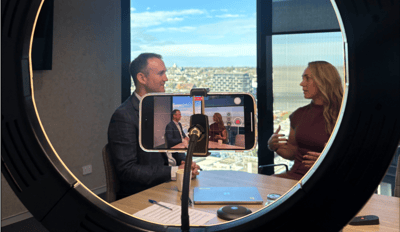
The harder part is that the women they would love to bring in are not always there to introduce, and the reasons start long before a role opens. We sat down with Chemical Engineer Sonya Andrew, five years into her career across paper manufacturing and now pharmaceuticals, to understand why.
Sonya's story
Sonya's way into engineering had a face on it. Her father is a Mechanical Engineer, and that proximity did what no careers brochure could. "I had an early window into what an engineering career looked like," she told us, "so a lot of the things people would call barriers had already been talked through with me."
For a lot of young women, capability was never the problem. The field stays abstract until you see the life up close, and abstract is easy to talk yourself out of. Sonya chose chemical engineering on her strengths and on range. "The industry base is large. You can go into almost anything, from paper to pharmaceuticals."
What the work has been like
Sonya is refreshingly unbothered by the version of this story people expect. Her current employer runs close to a 50/50 gender split, though she is honest that the picture narrows higher up, where senior engineering roles are still mostly held by men.
She has felt the underestimation that comes with that. "I've had to deal with being underestimated and actively proving my technical credibility, and I see that as part of the experience." What she will not do is hand that experience more weight than it deserves. In an earlier role at a paper mill she was the only female engineer on the team, and she describes it as one of her most positive years. Many of the older operators had daughters her age and treated her with real respect and warmth, and she was always made to feel included.
Her advice to women weighing up the field comes straight from that. "Don't assume a male-dominated environment is going to be a hostile one. If you do solid technical work, that earns respect pretty quickly." She is equally clear that you do not have to be the loudest person in the room to belong in it. "Some people don't speak up much, but they're still really solid technically, so their work speaks for them."
Where the work is
Sonya named two things that sit almost entirely in the employer's hands, and both are useful to the businesses asking us how to change their numbers.
The first is the pipeline, and it starts at university. "A lot of companies want previous industry experience, which is hard to get when you're focused on your subjects. If businesses could guarantee an internship or a graduate pipeline, it would be far easier to break into the industry." It is also why a search for women in some technical roles comes up short. We cannot connect a business with women who were never given a way in, and the way in is built three and four years before the role exists.
The second is what happens later, around the five to ten year mark, when many women are forming families. Sonya has watched it play out around her. "I've seen women take a step back after starting a family, and when a promotion comes around they get overlooked. I don't think people mean to do it. There should be more ways for a career not to stall just because someone wants a family." The businesses moving fastest here are rethinking what flexibility looks like for an experienced engineer, where so much of the work has become strategic rather than purely hands-on, and they are keeping good people they would otherwise lose.
The part worth carrying
What stays with us from Sonya is how ordinary she makes it all sound. She talks about engineering as a place worth walking into, where good work gets noticed and the right people back you while you find your feet. If you are a woman starting out in engineering, or still deciding whether it is for you, that is worth hearing from someone five years down the track.
The numbers will not move from the top alone. They move when businesses build a way in early, and keep listening to the women already in the field about what would make them stay. Plenty of leaders are starting to do exactly that. The ones who treat it as something to invest in, and then follow through, are the ones who will look up in a few years and find their teams have changed.

Looking for your next Engineering opportunity?
Careers like Sonya's rarely follow a straight line, and the right conversation early can change the shape of one. If you want to talk through where yours could head, speak to the team.
Related articles

leadership, career advice
Degrees are declining but expectations are rising
The qualification gap - why your degree matters less than what you've done since

leadership
The unicorn problem: Why expectations are unrealistic
Most senior briefs arrive with a long check list. AI literacy, digital transformation experience,...

leadership, employee value proposition (EVP)
Community over compliance: The future of the office
Nobody is winning the return-to-office argument - because it's the wrong argument.
executive search, career advice, accounting and finance
Back Yourself - My first year as a Fractional CFO
"I like to make myself redundant," says Bree Taylor. It sounds like an odd goal to set for your own...

market insights, leadership
Technical vs leadership capability - does one matter more than the other?
For much of the past two decades, technical expertise was the currency that carried senior careers...