




By: Rohan McMaster
"I like to make myself redundant," says Bree Taylor. It sounds like an odd goal to set for your own career or business, until she explains it.
For her, success means helping clients reach a point where they no longer need the same level of support—because the systems run independently, the existing finance team has been upskilled to step into the role, or the business has grown enough to justify a full-time CFO. Rather than stepping away entirely, her work may then evolve into high-touch strategic advisory, supporting the leadership team through complex decisions, new opportunities and periods of change.
That's the measure Bree uses 12 months into building her own fractional CFO firm. Someone first raised the idea with her while she was settled in a full-time role she was enjoying. The conversation didn't turn into a decision that day - it sat in the background instead, resurfacing when she was ready to back herself.
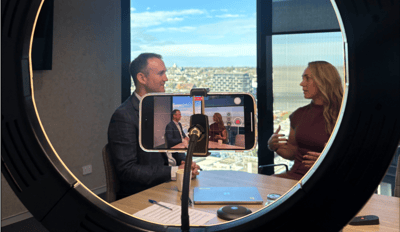
The notorious gap between an idea and a decision says something true about how fractional careers form. Rohan McMaster, who leads the Accounting and Finance Executive Search practice at Six Degrees, sat down with Bree to unpack what building a fractional CFO firm looks like, from her first LinkedIn post to the clients she works with now.
A decision that built slowly, then moved fast
Bree had always wanted to build something of her own. "It's something that I've always wanted to do, as in build my own business, but I had no idea what that looked like," she says.
"I finished up working in my full-time role after making myself redundant, really, which was sort of what I was really trying to do," she explains, meaning she had developed the systems and capabilities for the business to function independently of her. Two months of testing the idea with mentors followed before she committed, in October, to putting it out into the market. "It was really scary to actually put myself out there and really put it out to the world that that's what I was going to do."
A structure, not more hours
Going fractional changed the shape of Bree’s week more than it changed the hours in it. "I've got a really good structure where I make sure I work 7 to 3.30, so I've got time with the kids,” she says. She is strict about blocking that time in her calendar and, when the work day ends, turning off the computer, shutting the door, and walking out of her home office. Evening and weekend work still happens. The difference is she is now the one who decides when.
"It's your business, it's exciting to do and it's something that I really enjoy doing” she adds.
Building a client base from nothing
Going out on her own meant starting without a pipeline. Rohan asked how she approached that from a planning and strategy point of view. "For me, I was really lucky that I had some great referrals come to me,” Bree says, including from people she had worked with previously.
The market itself has helped too. "The world of fractional is becoming bigger in Australia” she says, pointing to the growth of platforms focused specifically on fractional work. “Getting out there on LinkedIn and getting into networking events and different panels” has also given her opportunities to talk directly with people about what she does.
None of it, in her view, is a numbers game. "I think a lot of what we do is really trust-based, so it's not a big marketing play, but it's really getting to know people and them really feeling comfortable with you."
Wearing several hats without dropping one
With multiple clients running at once, Rohan asked how Bree manages competing priorities. "This one seems to have come quite easily; I guess because I've always worked in sort of fast-paced project-based businesses. So wearing many hats and jumping between priorities is sort of what I've always done," she says. Each client receives focused attention against clearly agreed priorities, despite Bree working across several businesses. She sets clear priorities and expectations with each client, blocks out focused periods of time and avoids trying to progress too many tasks at once. Asked what a typical week looks like in practice, Bree lays it out plainly. "I try and plan out the week in advance”. Monday mornings are used to map out priorities, recurring reports and month-end requirements. She also makes time to attend leadership and key stakeholder meetings and to mentor members of her clients’ teams. The client work itself shifts by the week. "For one client, I might be looking at the cash forecasts for the next three months. One client, we might be working on a margin analysis for a new product that they're launching. Other things might be budgeting or new year planning, which is what we're doing at the moment."
The trust question employers keep asking
For businesses weighing up fractional support, the hesitation is rarely about capability. It's about proximity. As Rohan put it to Bree directly: "There's often a perception that fractional support is remote or transactional. How do you become genuinely embedded in a client's business? How do you create trust?"
Bree’s answer starts with rejecting the label itself. "I don't like the virtual CFO labels. I like to really embed myself in the businesses. I love to go into their offices,” she says. The value sits outside the formal calendar. "What you're able to learn from key stakeholders, just having general conversations is so much more important and enlightens you to the wider business rather than a formal leadership meeting that you might have once a month."
That same sense of ownership carries through to implementation. "I have always treated the businesses I have worked for as my own, and that's the same with my clients.” she says. “A strategy means nothing. The implementation is really the important part,"
Where the economics work
Rohan brought the conversation to the businesses on the other side of this decision. "We work with several clients in the small to medium space, who can't necessarily afford a full-time CFO. We have these conversations all the time. What would you say are the benefits to those sorts of clients in terms of fractional CFO work?"
Bree’s view has a rough shape to it. "I believe that any business below, say, 3 mil probably doesn't need a full-time CFO,” she says. Above that point, the right model depends on more than revenue alone. The business’s complexity, rate of growth, cash pressures, internal finance capability and plans for expansion, acquisition or succession all shape the level of support required. Somewhere between half a day and three days a week is the usual range before the case for full-time support becomes clear. "They get the benefit of what feels like and is, in essence, a full-time team member for a fraction of the cost." The value is not simply a lower cost. It gives the business access to senior financial capability without committing to a full-time cost structure before the need is there.
That's the same tipping point behind Bree’s aim to “make herself redundant” . When a client's systems and internal capabilities have matured, or the business grows large enough to justify a full-time hire, she can step back from the day to day. The goal is not to remove herself from the relationship entirely, but to help the business become less dependent on her operationally while remaining available strategically, where her experience adds the most value.
What she'd tell someone still deciding
Asked what she'd tell a finance leader weighing the same move, Bree’s advice was immediate. "I reckon the biggest one is do it and back yourself."
The second piece can feel counterintuitive for anyone trying to build a client base fast. "Really hone in on your key client”, she says. There can be a tendency in the early stages of business to cast the net too wide, rather than finding a niche, clearly articulating the ideal client and doubling down on it. “Making sure the market understands who that client is and what you actually do and who you support most,"
The part that surprised her most wasn't finance at all. "I'm absolutely an introvert at heart. I would rather sit in a corner and talk to nobody. But over time the new business meetings that I have and the networking that I do really brings me joy and energises me," she says. Twelve months in, she's now building out support of her own. "I've just recently decided that I'm really going to expand out a team that can support me. That might be FP&A professionals, other CFOs that come in and support the clients, as well as some sort of admin support as well."
Fractional and full-time CFO work aren't competing models so much as two points on the same map, and businesses move between them as their needs change. Most of our work sits on the full-time side of that map, with businesses once they've reached the point Bree describes and are ready to bring that capability in-house. Conversations like this one are a reminder of how interconnected the finance leadership market is!
.jpg?width=2000&height=1125&name=MVP%20(4096%20x%202304%20px).jpg)
Looking to hire your next Finance leader?
The opportunity isn't gone. It's just harder to reach. And the talent that can take you there is still out there, if you know where (and how) to look. Reach out to the Executive Search team below for a confidential chat.
Related articles
executive search, career advice, accounting and finance
Back Yourself - My first year as a Fractional CFO
"I like to make myself redundant," says Bree Taylor. It sounds like an odd goal to set for your own...

market insights, leadership
Technical vs leadership capability - does one matter more than the other?
For much of the past two decades, technical expertise was the currency that carried senior careers...

market insights, engineering, career advice
Getting more women into engineering starts earlier than you think
We often hear a different version of the same thing from clients across manufacturing, industrial...

market insights, consumer and fmcg, leadership, retail, marketing
The succession problem that needs addressing
When a senior leader resigns there is quite often a sense of urgency that tags along when searching...

market insights, retail, marketing
What the data tells us about the Retail market in 2026
Written by Lucy Garrido & Maisie Sheffield Between us, we spend a lot of time talking to retail...