




Well-crafted and insightful questions are the best way to gain credibility with your audience and sell yourself, without actually selling. So why do so few people utilise them?
“We run this company on questions, not answers.”
Eric Schmidt, CEO of Google
TL;DR
High-impact questions are a powerful way for job candidates to demonstrate their commercial and industry expertise, leaving a memorable and credible impression on the interviewer.
Key Takeaways:
-
Well-crafted and insightful questions are the best method to gain credibility and promote yourself without explicitly 'selling'.
-
A single, well-thought-out, high-impact question can leave a significant impression on the interviewer.
-
A high-impact question must combine three elements: business/commercial acumen, industry knowledge, and professional questioning skills.
-
Demonstrating commercial acumen shows a thorough understanding of the company and a genuine interest in the role.
-
Highlighting industry knowledge proves you are connected to relevant news and macro impacts, establishing you as an expert in your field.
-
Effective questioning involves natural curiosity, active listening, and the ability to ask a challenging question politely to spark a deeper conversation.
High impact questions
Children learn by asking questions. Students learn by asking questions. New recruits learn by asking questions. Innovators understand needs by asking questions.
Brilliant thinkers never stop asking questions because they know that this is the best way to learn and gain deeper insights. Beyond this, you will also impress people with your knowledge and credibility, but only if you ask the right questions.
A lot of people underestimate the power of an effective, high-impact question. Tapping into this tool can help you in many situations such as interviewing, networking and business meetings. In the context of an interview, if you ask just one, well thought out, high impact question, you will be sure to leave an impression on the interviewer.
Elements of a high impact question
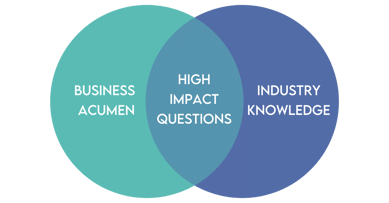
A high impact question requires a demonstration of business/commercial acumen (company knowledge) and industry knowledge, combined with your ability to ask a professional, challenging question that establishes your expertise.
Business/commercial acumen
When asking your interviewer a question, it is imperative to show them you have a thorough understanding of their company and the way it operates. Demonstrating your knowledge of the company shows them you are genuinely interested in the role and ready to immerse yourself in it should you be successful.
Industry knowledge
Demonstrating industry knowledge will show the interviewer that you are connected to relevant news and issues in the industry and aware of macro impacts on the business and broader parameters of your potential new role. Showing a deeper understanding of how the industry impacts on your role, set against the competitive landscape demonstrates to the interviewer you are an expert in your field.
Questioning skills
The ability to demonstrate natural curiosity is one of the most important questioning skills, as it shows the interviewer you are eager to learn and ready to take on new challenges. Along with this, it is important to listen attentively to what your interviewer is saying. This allows you to respond with clear, concise questions that are relevant to the conversation and allows the interviewer to provide an informative response. Don’t be afraid to ask a challenging question (politely of course!). These are often the questions that will provoke the most interesting flow on conversation which will be sure to leave an impact.
Here are some examples of high impact questions:
I understand the nature of your industry is highly fragmented, with the four majors and then a long tail of SMEs (industry knowledge), and while you’ve got 20% market share as the leader (company knowledge), what is your organisation doing about growing that position? (Asking the challenging question)
The industry is coming down on chain of responsibility/transport safety because of widespread non-conformance/governance issues (industry knowledge); and I know that your organisation has just experienced a road fatality (company knowledge). What immediate changes have you made to ensure this doesn’t occur again? (Asking the challenging question)
Using this formula to ask questions will deliver a powerful, concise and insight-provoking question every time.

Related articles