




Last week we welcomed senior leaders from across Australia's FMCG, retail and consumer landscape back to the Digital Shelf Future Forum in Melbourne, hosted in partnership with Arktic Fox.
If last year's forum was about preparing for digital commerce change, this year was about navigating it. Marketplaces and quick commerce are no longer emerging channels, they're mainstream. AI is starting to sit between shoppers and the brands they buy from, product content is becoming business-critical infrastructure and retail media investment is accelerating faster than most businesses' ability to measure whether it's working.
The line that carried through the entire morning came early, and it stuck:
"What got you here won't future-proof your next five years."
Setting the tone
Opening the day, Teresa Sperti and Maya Wettenhall shared the findings from this year's Arktic Fox and Six Degrees Executive research into the retail and brand landscape.
The numbers were what the scene - $18.9 billion was spent through online marketplaces in Australia in 2025, meaning $1 in every $4 spent online now goes through a marketplace. 66% of Australians had purchased through a quick commerce platform in the previous 12 months. Nearly two-thirds of brands now rank digital shelf and product content as a strategic priority in 2026, up from just 33% a year earlier.
AI's influence is accelerating faster than most businesses are watching it, 71% of leaders believe AI and agentic commerce will have a significant impact on how shoppers buy, yet only 34% are actively monitoring the space. And on retail media, almost three in four brands are still struggling to quantify the return, with just 5% reporting high trust in retail media networks.
Teresa and Maya brought the conversation back to what all of this means for people and teams, not just platforms and budgets. As Teresa put it:
"Hire for learning aptitude, not just current skill; the tools will keep changing faster than any job description can."
Winning in the AI commerce era
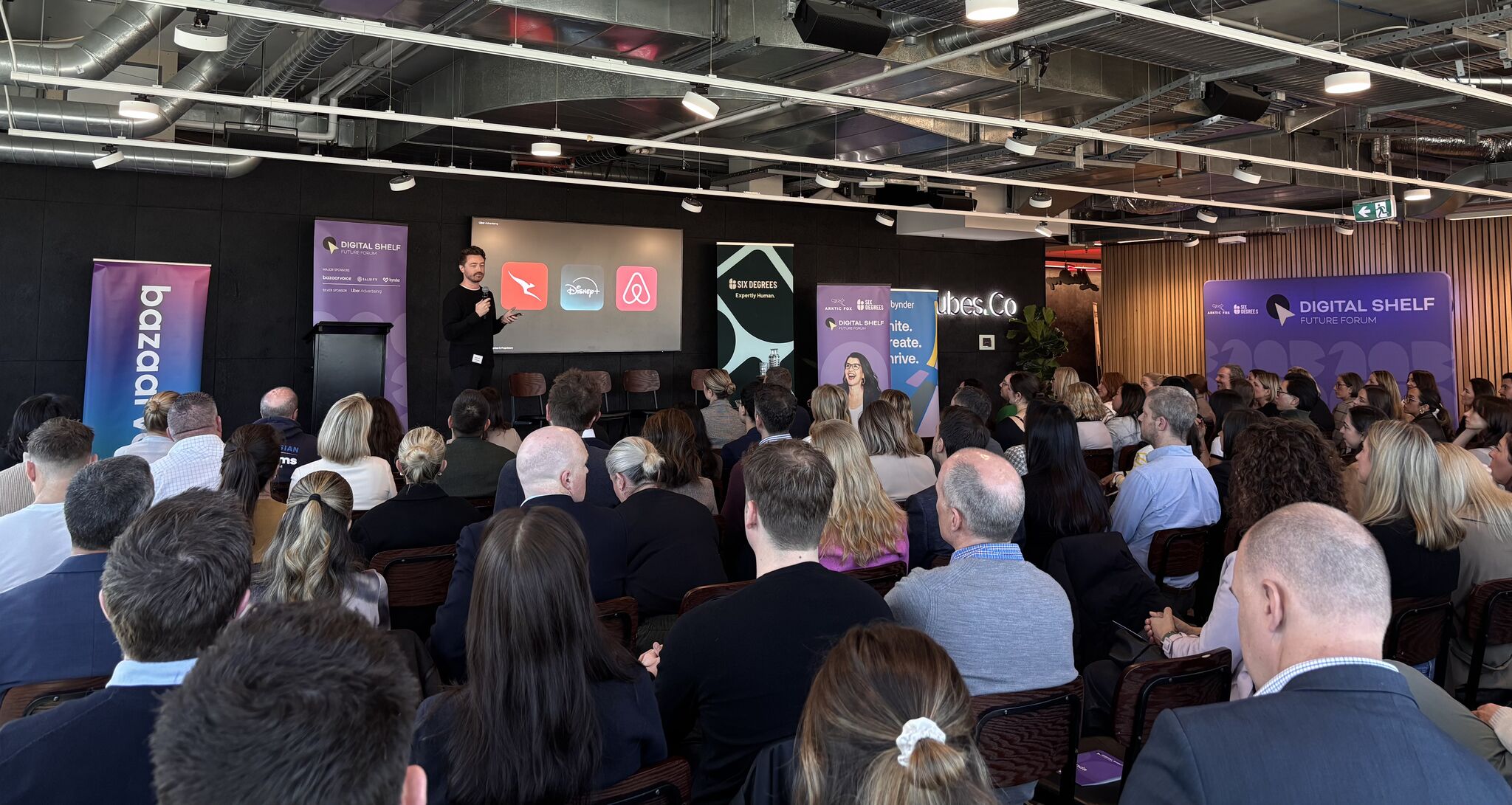
Roger Dunn explored what happens as AI increasingly inserts itself into the shopping journey. Traditional search isn't disappearing, but AI-driven discovery is adding a new layer on top of it, one where shopper prompts in tools like ChatGPT and Gemini can be far more detailed and contextual than a traditional search keyword ever was.
The implication for brands is a shift in what "winning" the digital shelf actually means. It's no longer enough to rank in search. Brands now need to think about whether their products are recommended and selected by AI itself, a change that touches product data, discoverability, brand positioning and potentially advertising all at once. Roger's session pointed to a genuine long-tail opportunity here: AI can interpret far more nuanced customer needs than keyword search ever could, for the brands that build the foundations to be found.
When AI starts shopping
Katrina Park and Octavia M. unpacked AI-led shopping from a retail perspective, landing on a theme that ran counter to a lot of assumptions in the room: more AI doesn't make human understanding less important. It can make it more valuable.
Shopping decisions, they argued, are often deeply contextual and emotional, particularly in categories like gifting. Product content that describes the technical properties of an item can miss the actual job the customer is trying to do, a parent buying a bath bomb isn't buying a bath bomb, they're buying a way to get a five-year-old into the bath. As AI makes it easier than ever to generate and scale content, that human context becomes a genuine point of difference rather than a nice-to-have.
Partnership and category management in a changing landscape
Jennifer Kenworthy and Gavin Vandeligt explored how category management and retailer partnerships are evolving as retailers themselves develop more sophisticated AI and data capability.
The panel discussed how online and in-store shoppers can have genuinely different needs, shaping everything from pack sizes to gifting ranges. On capability, Gavin shared his own experience of initially trying to build eCommerce expertise entirely from within the existing team, before bringing in people with established experience who could introduce new thinking and upskill the wider organisation from there. The maturity journey that emerged was a simple one: get the fundamentals right, test and learn, then invest further once the KPIs and opportunities become clearer.
The quick commerce opportunity
Matt McGinley and Ben O. joined Teresa to unpack how quickly quick commerce has moved from a novelty into an embedded shopper behaviour. Convenience, the panel agreed, has shifted from a luxury to an expectation, and quick commerce is increasingly less about speed and more about the relief of having something taken care of, whether that's a forgotten grocery item, a late-night craving, or getting ready for guests without a trip to the shops.
The range of what's now moving through these platforms makes the shift tangible. As Mi3 reported following the event, Uber Eats now carries goods from retailers including Officeworks and Bunnings, with McGinley telling attendees the platform is "now actively selling lawnmowers." Ben Oliver, from Mars Pet Nutrition, shared that the brand's sales through Uber Eats are catching up to Amazon, driven in part by more than 70% of Uber's customers being Gen Z or millennials, a generation that expects friction removed from every purchase, not just the urgent ones.
The panel was candid about the harder question sitting underneath all of this growth: is retail media advertising creating genuinely new sales, or simply claiming credit for ones that would have happened anyway? Oliver's answer, only half in jest, was blunt: "For the love of God, don't look at attribution." Mars is instead pushing for incrementality testing and marketing-mix modelling over platform-reported numbers, a sign of how unresolved measurement still is even for a business operating at that scale.
Building the foundations for AI discovery
Kate Musgrove, Kévin Penhouet and Gillian Smythe, moderated by Jo Krause, tackled one of the day's most practical questions: what does it actually take for a brand to be found by AI, not just by shoppers?
The panel's answer centred on treating content less like a marketing task and more like a supply chain. Accurate, consistent and complete product data remains fundamental, and reviews and user-generated content are becoming genuine trust signals for both shoppers and AI systems alike. As AI takes on more of the repetitive enrichment and personalisation work, brand truth, voice and governance still require human oversight, and small teams can't manually manage unique content across a growing number of channels indefinitely. The clear message: before racing toward AI-generated content, audit the processes, data and technology foundations sitting underneath it.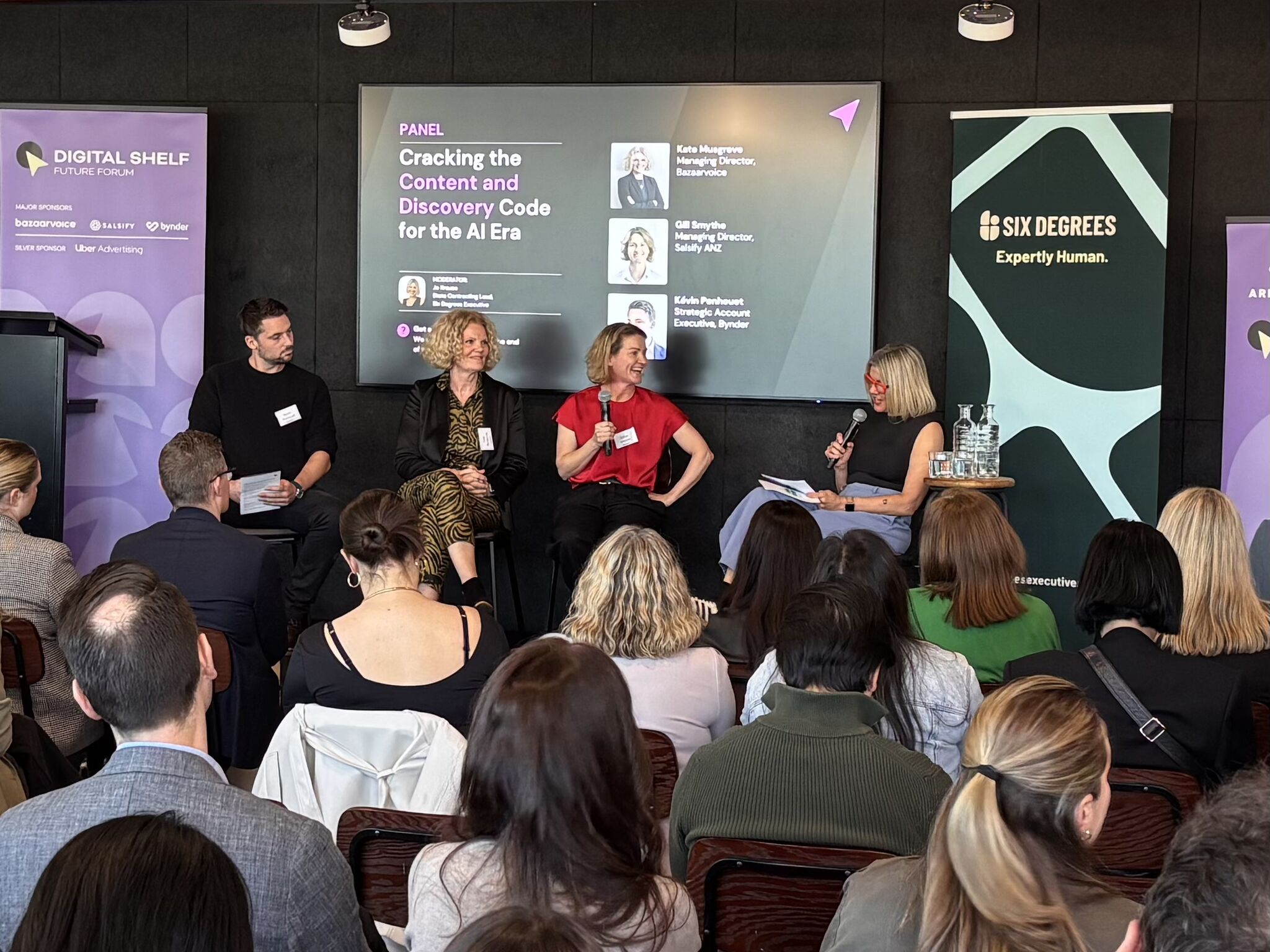
Inside RYOBI's digital shelf journey
Vera Skocic and Natalie Rogers gave attendees one of the day's most practical case studies, taking the room inside how RYOBI has approached the digital shelf as an extension of the physical shelf, not simply a content exercise.
The starting point was an honest audit of where the business actually stood, followed by training that gave teams across the organisation a shared language and a customer-first perspective. Vera described the digital shelf as "everyone's opportunity" rather than the responsibility of a single team, a philosophy that showed up in one particularly telling example: a gap between RYOBI's internal stock data and what customers actually saw on the Bunnings website, caused by differing business rules between the two systems. Rather than trying to fix everything at once, the team prioritised its hero SKUs first and built maturity from there.
Making retail media measurement mean something
To close the day, Tenielle Wibskov, Ana Laskova and Joe Shaw tackled the challenge identified right back in the morning's opening research: brands are investing heavily in retail media but still struggling to prove its worth.
Their starting point was that measurement needs to begin with the business objective, not the metric a platform happens to report. That means looking beyond campaign dashboards and ROAS to POS and scan data, market share, shopper panels, loyalty data and brand health, and treating retail media as media in its own right rather than purely a lower-funnel sales lever. Marketing mix modelling can offer a strategic, business-wide view and help translate results into language senior leadership actually understands, though the panel was clear it isn't a silver bullet on its own. The clearest takeaway of the session, and arguably the day: measurement only matters if the business actually acts on what it learns.
Closing reflections
One message carried through every session of the morning: the technology will keep changing, and the channels will keep evolving, but the businesses best placed to navigate what's next will be the ones willing to test, learn and adapt, with the right people and capability around them to do it.
Thank you to Teresa and Maya for bringing another Digital Shelf Future Forum to life, to our MC Natalie, to every speaker and panellist who shared their experience so openly, and to our sponsors Bazaarvoice, Salsify, Bynder and Uber Advertising for supporting the day.
If you'd like to speak to our team about hiring the right people to support your marketing, digital or eCommerce strategy, please reach out below.

Related articles


-1.jpeg?width=400&name=IMG_2526%20(1)-1.jpeg)