




AI has become impossible to avoid in marketing conversations, but far less has been said about how it's actually playing out inside hiring decisions. This was the reason Michelle brought together four senior marketing leaders for a live panel discussion - not to debate whether AI is coming for marketing jobs, but to unpack what employers are looking for and how marketers can position themselves with confidence.
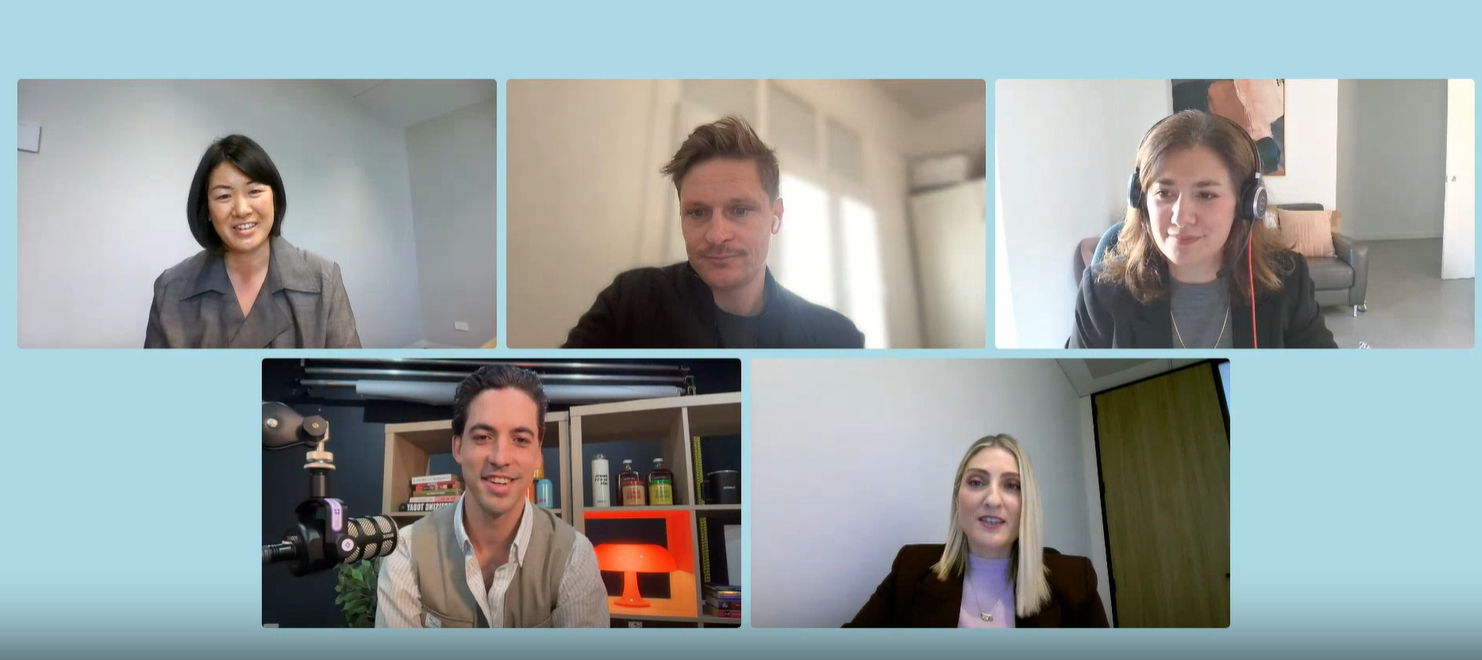
Hosted by Michelle Young from Six Degrees Executive, the panel featured David Jennings (EGM Marketing, Lifestyle Communities), Kylie Lewis (Head of Digital, EnergyAustralia), Anita Hajdinjak (GM Customer Engagement, Personalisation & Go-to-Market, Bupa), and Sam Ayre (Head of Marketing, Cuttable). The conversation was candid, occasionally divided, and grounded in what each of them is actually seeing inside their own teams.
As Michelle opened the session:
"The conversation has moved on from 'will AI take our jobs?' - the data tells a more interesting story. AI isn't replacing jobs, it's splitting them into two tracks... the more AI is deployed, the more the human skills matter."
Hiring trends: augmentation, not replacement
The panel's first point of near-unanimous agreement was that AI is changing what marketers need to deliver, not eliminating the need for them.
David set the tone early, describing what he calls the "3x marketer":
"AI is largely augmenting marketing teams and not replacing them... I'm not yet in the camp of AI replacing marketing talent, but I think AI is certainly amplifying the best marketing talent."
Kylie agreed the change is about function, not headcount:
"I don't think roles are necessarily disappearing, but the function and the skill sets of the roles are definitely changing... mindset is becoming more important."
Anita reframed the real risk facing marketers - and it isn't job loss:
"The risk is really around standing still in your career, as opposed to how you can grow and become someone who can work really effectively with AI."
Sam offered a sharper, more commercial lens, drawing a clear line between businesses using AI to grow versus businesses using it to cut:
"There's this mentality, certainly from a hiring trend point of view, that is dissipating - that AI is a cost cutter... the best brands, the most ambitious brands, the brands who are growing are using it to grow, not the other way."
What traits matter now
With technical AI skills increasingly accessible to everyone, the panel turned to what's becoming harder to find - and more valuable.
David's answer was learning agility:
"The people who are thriving aren't necessarily the ones that have all the answers - they're the ones that can adapt and learn... when I'd hire, I'm increasingly looking for learners, and leaders by the same vein."
Kylie pointed to judgement and critical thinking as the gap AI can't close:
"AI can't do yet, in my experience, is applying that real curiosity and critical thinking and judgement... it's using the past to determine what it's providing you. It can't imagine the future."
Taken together, the panel's opening exchange set up the theme that ran through the rest of the session: AI is reshaping expectations of marketers, not removing the need for them - and the marketers who understand that distinction early are the ones best placed to benefit from it.
How hiring decisions have been effected
This is where the panel's perspectives diverged most - and it turned out to be one of the more practical parts of the session, since it showed candidates that "how AI has changed hiring" doesn't have one universal answer. It depends heavily on the type of organisation you're applying to.
Sam, leading an AI-native company, was the most direct:
"To be bold and provocative, but I think for us anyway, the resume is a bit of a dead artifact... what we really look for is proof that they can really teach themselves something... proof that they've used AI to do something, not just talk about it."
Anita offered a genuinely different reality from inside a large, regulated business:
"Honestly speaking, our hiring process hasn't changed dramatically yet... we're still very much hiring for the fundamentals - capability, experience, cultural contribution."
Kylie described a hiring problem that's become a running theme across the market — CVs that all start to look the same:
"It literally looks like every CV is exactly the same. They sound the same, they look the same, it's really hard to stand out... I weirdly enjoy a typo, because I'm like, a human has been here."
Her advice for candidates:
"That bio, the 'why you' - I feel like that needs to be really personal and really stand out and be vulnerable, have an opinion, stand behind something. Don't let AI write that for you."
The contrast between Sam and Anita's experiences is worth sitting with: the pace of change in hiring practices isn't uniform across the market, and candidates would do well to research how a specific organisation is actually approaching AI in recruitment, rather than assuming every employer has moved at the same speed.
Team structures - from doers to orchestrators
David described the shift he's seeing inside his own team's structure:
"The biggest shift being marketers shifting from being doers to orchestrating the AI... it's better to have an AI agent in the org chart reporting to you than us all having to report to the AI."
Sam pointed to entirely new hybrid roles emerging across the industry:
"There's a lot of merging of new roles and a lot of creating of new roles in marketing... traditional roles like the media buyer and the designer, I'm seeing become one role... it's called a creative strategist."
For marketers thinking about their own career trajectory, this is a useful signal: the roles worth watching aren't necessarily new job titles from scratch, but existing specialisations merging together - meaning breadth across adjacent skills is becoming more valuable than depth in a single narrow lane.
Real AI use cases inside Marketing teams
The panel shared concrete examples of where AI is already changing day-to-day output.
David described a two-axis approach his team uses - balancing productivity gains against genuine growth opportunities, using AI-personalised customer communications as an example of the latter.
Kylie shared a practical example from her own workflow:
"I've now got an automation that actually listens to the first call, gives me the talking points for the next call and inputs the information into the report... then there's a little part of me that goes, we should just rethink all of this."
Anita spoke to the added complexity of using AI inside a regulated, sensitive-data business:
"That still requires human oversight as well, to make sure that what we're putting out there is accurate... there is definitely that governance that's critical."
Practical advice for marketers
Closing the session, each panellist offered their single best piece of advice for staying relevant.
David: "Get on the tools... get curious, get humble, and the clarity comes from the doing. There's no other way to learn apart from the doing."
Kylie: "Learning AI is your individual responsibility at the moment... start by automating admin, and rethink the work end to end instead of just automating what you currently do."
Anita: "Just get out there. Don't ask for permission or wait for permission - just go out and experiment... think about how you can use AI to challenge your thinking, play that devil's advocate for you, poke holes in your strategy."
Sam: "Continue to build your network... find a few good people, even if you don't know them, reach out to them."
Unanswered (and most asked) questions
The chat was active throughout the session, and while the panel covered significant ground, there wasn't time to address every question live. Below, we've grouped the most common outstanding questions and provided our take.
Q: What's your take on AI screening or conducting interviews (AI-run interviews, "AI Apply" tools)?
Six Degrees Executive's process remains fully human-reviewed - we believe context and nuance are still hard to replace with automated screening, particularly for senior roles.
Q: Are marketers overlooking non-LLM AI/ML (forecasting, segmentation, optimisation)?
Yes - predictive and optimisation-based AI has been embedded in marketing analytics and CRM platforms for years, well before generative AI became the focus. Fluency in both is a differentiator, not just knowing how to use a chatbot.
Q: How do you assess someone's ability to work with company context and data, not just use AI tools generally?
Look at how a candidate explains a past decision - can they say why they made a call, not just describe what the AI produced. That judgement is what signals real capability versus surface-level tool use.
Q: What should mature-age (50+) candidates focus on?
Age isn't the differentiator here - if anything, you've navigated more industry shifts and transitions than most, and that adaptability is a genuine advantage. The strongest position is combining deep experience and new AI-driven ways of working. Bring the judgement and pattern-recognition that only comes from experience, paired with a genuine willingness to get hands-on with the tools - which is a combination hard to compete with.
Q: Beyond growth mindset, what skills matter specifically for senior CX/client intelligence roles?
The skill that consistently separates strong candidates the ability to distil complex data into a clear story and influence stakeholders with it. Plenty of analysts can interrogate the numbers; far fewer can translate that into something compelling enough to change a decision in the room. A combination of sharp analysis paired with storytelling is rare, and it's exactly what we look for.
Q: How do you protect job satisfaction as AI increases output expectations?
Use the time AI frees up for higher-value, more engaging work rather than letting it get absorbed into higher targets - and raise it directly with your manager if that's happening. It's a conversation worth having early, not after burnout sets in.
Q: My organisation has low AI adoption — what's a genuine next step?
Start small and self-directed: automate one repetitive task using free tools, and build the habit before waiting for formal training. You can even use AI itself to teach you how to build a specific skill or workflow.
Q: AI CV-checker tools give wildly different compatibility scores for the same CV — how should I interpret that?
These tools vary significantly in what they're actually measuring, so no single score should be treated as definitive. Our own process at Six Degrees Executive remains human-reviewed rather than automated for exactly this reason.
If you missed the session, you can watch the on demand webinar here
This webinar was created to help marketers move past the noise around AI and get a clear, practical read on what's genuinely changing - in hiring, in team structures, and in the skillsets needed today. If you'd like to speak with our marketing team about your career, the market, or how to position yourself in the age of AI, we would always welcome the conversation!

Related articles
-1.jpeg?width=400&name=IMG_2526%20(1)-1.jpeg)